


What a Cognitive Loop Is and Why It’s So Hard to Exit
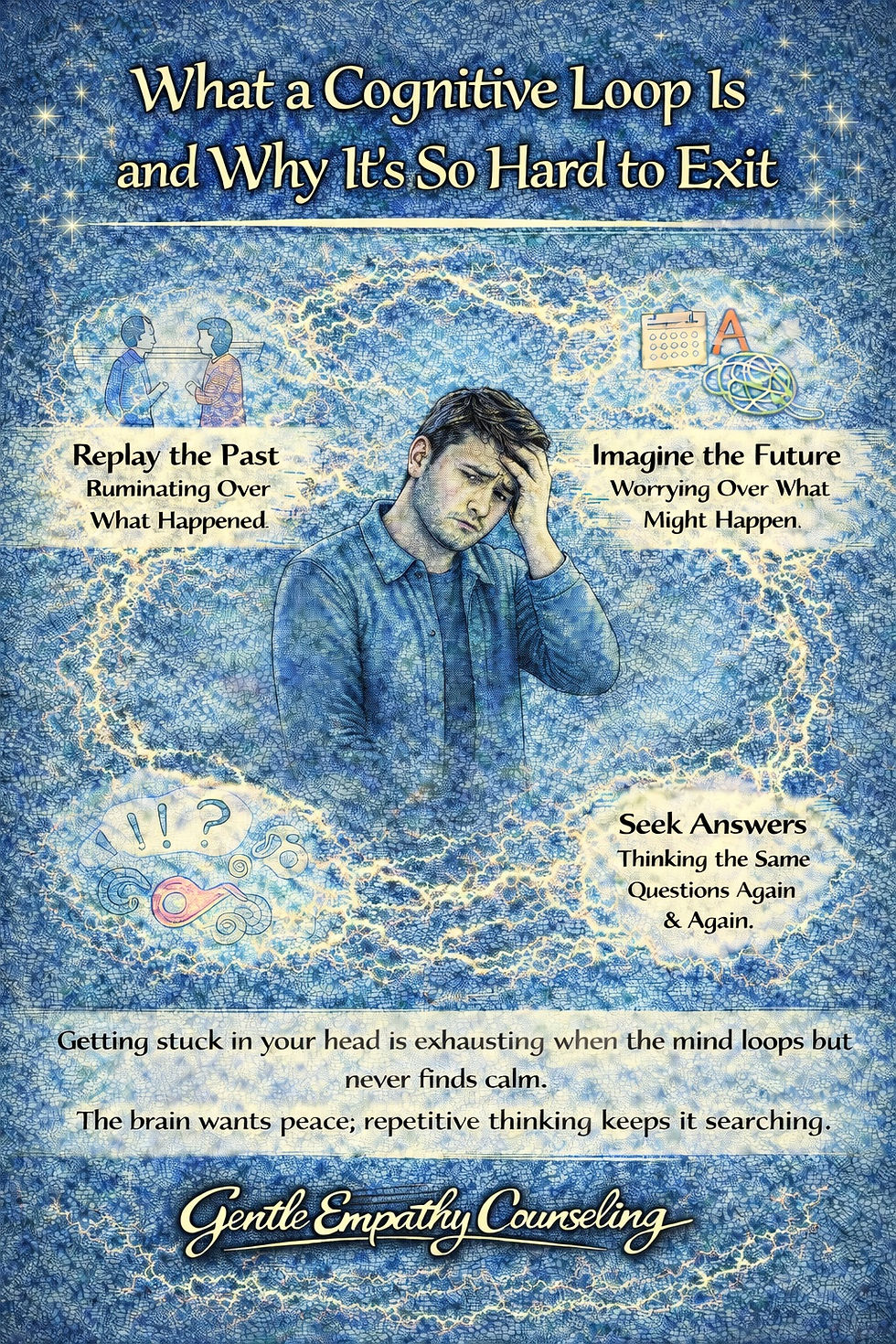
Many people describe feeling trapped in their own thoughts. The same worries, questions, or memories repeat, even when they know the thinking is not helping. The mind circles familiar territory, searching for resolution, yet never quite arriving.
This experience is often called a cognitive loop. It can feel exhausting, frustrating, and confusing, especially when insight alone does not seem to create relief.
What Cognitive Loops Look Like
Cognitive loops often involve replaying conversations, anticipating future outcomes, or revisiting past decisions repeatedly. You may analyze what you said, what someone else meant, or how a situation might unfold if you make the wrong move.
The content of the thoughts may shift slightly, but the pattern remains the same. Each pass through the loop feels urgent, even when it sounds familiar. Over time, this repetition can crowd out mental rest and make it difficult to focus on the present moment.
Many people describe feeling mentally busy but emotionally stuck.
Why the Brain Gets Stuck
The brain is designed to notice potential threats and resolve uncertainty. When a situation feels emotionally charged but unresolved, the brain keeps searching for answers. It scans for mistakes, risks, or missing information in an effort to restore a sense of safety.
Anxiety fuels this repetition. The mind believes that if it keeps thinking, it will eventually find certainty or relief. From the brain’s perspective, stopping the search feels risky.
Instead of resolving the discomfort, the loop continues, reinforcing the sense that something important is unfinished.
Why Insight Alone Often Fails
Many people understand their patterns very well. They know they are overthinking. They recognize the loop and can even explain where it came from.
Insight alone does not stop cognitive loops because the issue is not a lack of understanding. It is nervous system activation. When the body remains on alert, the mind continues its efforts to protect, even when logic says it is unnecessary.
This is why telling yourself to stop thinking rarely works. The system is responding to perceived threat, not faulty reasoning.
Why Loops Feel Compulsive
Cognitive loops can feel compulsive because they offer brief moments of reassurance. For a short time, thinking feels productive or soothing. You may feel slightly calmer when you believe you are getting closer to an answer.
When anxiety returns, the loop restarts. The relief fades, and the mind re engages, hoping that one more pass will finally resolve the discomfort.
Over time, this cycle can feel automatic and difficult to interrupt, even when it causes distress.
What Actually Helps Loops Loosen
Because cognitive loops are tied to nervous system activation, relief often comes through approaches that address both mind and body. This may include learning how to settle physiological arousal, increasing tolerance for uncertainty, and shifting the relationship you have with your thoughts rather than trying to eliminate them.
Gentle interruption, not force, tends to be more effective. Safety signals, grounding, and compassion help the system stand down so the mind no longer feels required to keep looping.
Could Therapy Help?
If you recognize yourself in these patterns, therapy can help interrupt cognitive loops in ways that feel safe and supportive. You do not have to fight your thoughts or judge yourself for having them.
At Gentle Empathy Counseling, we help clients understand why their minds get stuck and learn how to step out of repetition with greater ease. Together, we focus on restoring a sense of safety, flexibility, and choice, so thinking no longer feels like a trap.
Sometimes the goal is not to stop thinking altogether. It is to help your system feel calm enough that it no longer needs to keep searching.



Comments