


Why Do I Keep Second-Guessing Myself?

Why Do I Keep Second-Guessing Myself?
You make a decision, then immediately begin wondering whether it was the right one.
You send a message, then reread it several times, searching for anything that might have sounded awkward, insensitive, or unclear. You leave a conversation and replay what was said, trying to determine whether the other person was upset with you. You ask someone you trust what they think, feel reassured for a little while, and then find yourself asking someone else.
Sometimes the decision itself is small. What should you wear? Which restaurant should you choose? Was it acceptable to decline an invitation?
At other times, the stakes are much higher. Should you remain in a relationship? Accept a new job? Set a boundary? Confront a problem? Trust your reaction to something that happened?
When second-guessing becomes a pattern, even ordinary decisions can become exhausting. You may begin to believe that other people understand situations more clearly than you do. You may assume that uncertainty means you are making a mistake. Eventually, you may stop trusting not only your decisions, but also your feelings, needs, memories, and perceptions.
This does not necessarily mean that you are indecisive by nature. Chronic second-guessing often develops for understandable reasons.
Healthy self-trust does not mean believing that you are always right. It means believing that your experience is worthy of honest attention.
What Chronic Second-Guessing Can Look Like
Thoughtful people reconsider decisions. They listen to feedback, recognize their limitations, and change course when new information becomes available. That kind of reflection is a strength.
Chronic second-guessing is different. It does not usually lead to greater clarity. Instead, it keeps reopening questions that have already been considered.
You might recognize the pattern if you frequently:
Replay conversations to determine whether you said something wrong
Ask several people for reassurance before making a choice
Change a decision when someone seems disappointed
Assume another person’s interpretation must be more accurate than yours
Feel guilty for having needs, preferences, or emotional reactions
Spend excessive time researching relatively small decisions
Delay acting until you feel completely certain
Interpret discomfort after a decision as proof that the decision was wrong
Apologize when you have not done anything harmful
Need someone else to confirm that your feelings are reasonable
The common thread is not simply uncertainty. Everyone experiences uncertainty. The deeper issue is the belief that you cannot be trusted to respond well when certainty is unavailable.
Why You May Have Learned to Distrust Yourself
Self-doubt rarely appears without a history. It often develops through repeated experiences that teach a person to question what they notice, feel, or need.
Anxiety Makes Possibilities Feel Like Warnings
Anxiety is skilled at generating possibilities.
What if I misunderstood? What if they are angry? What if I regret this? What if there is an option I have not considered? What if something goes wrong and it is my fault?
The anxious mind often treats the existence of a feared possibility as evidence that the possibility deserves more attention. Because no amount of thinking can eliminate every risk, the search for certainty continues.
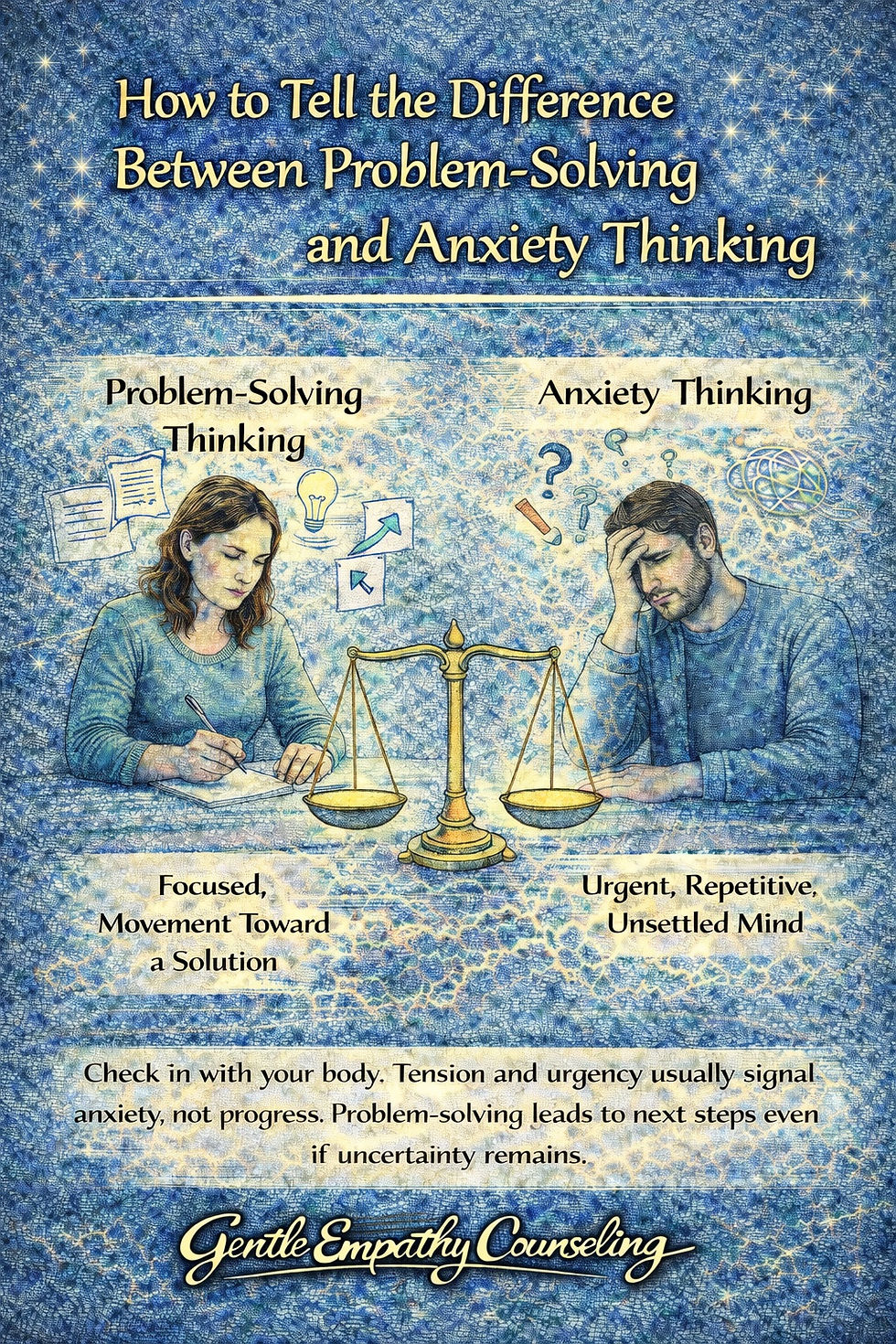
This is one reason second-guessing overlaps so easily with overthinking. The mind keeps working because it believes one more round of analysis might finally produce safety. As explored in Why You Overthink Everything and Still Don’t Feel Better, thinking can begin as an effort to find relief while gradually becoming another source of distress.
Perfectionism Raises the Standard for a “Good” Decision
Perfectionism can create the expectation that a correct decision should produce an ideal outcome.
In real life, however, wise decisions can still involve loss, discomfort, disappointment, or unintended consequences. Sometimes every available option has a cost. Sometimes we make the best choice we can with limited information.
If you believe a good decision must protect everyone from discomfort and guarantee that you will have no regrets, you may remain trapped in analysis. You are not merely trying to make a thoughtful choice. You are asking yourself to predict and control the future.
Criticism Can Make Mistakes Feel Dangerous
If mistakes were met with harsh criticism, ridicule, anger, or withdrawal earlier in your life, decision-making may carry more emotional weight than it appears to carry.
You may have learned that being wrong was not simply an opportunity to learn. It threatened your acceptance, safety, or sense of worth.
As an adult, you may still approach decisions as though each one is a test of your adequacy. A disappointing outcome does not feel like something that happened. It feels like evidence about who you are.
Relational Invalidation Can Weaken Confidence in Your Experience
Some people have repeatedly been told that they are too sensitive, too emotional, too demanding, or simply wrong about what they experienced.
Sometimes this happens in relationships where another person regularly dismisses concerns, rewrites events, or insists that only one interpretation is acceptable. It can also happen in families where maintaining peace requires one person to ignore personal needs or perceptions.
Over time, you may begin correcting yourself before anyone else has the opportunity.
Maybe I am overreacting.
Maybe I should not feel this way.
Maybe it was not that serious.
Maybe I am the problem.
It is important not to assume that every disagreement is invalidating or manipulative. People can remember events differently and interpret the same interaction in different ways. Still, if you have repeatedly learned that your perspective carries less weight than everyone else’s, self-doubt may become automatic.
Painful Decisions Can Make You Afraid to Trust Yourself Again
Sometimes self-doubt grows after a choice you deeply regret.
You may look back and believe you should have recognized warning signs, acted sooner, waited longer, or chosen differently. The mind then creates a rule: Never trust yourself so easily again.
Reflection can help us learn from experience. Punishing yourself indefinitely does not make future decisions wiser. It often makes them more fearful.
You made that earlier decision with the knowledge, emotional resources, needs, and circumstances you had at the time. There may be something important to learn from it. That is different from concluding that you are permanently incapable of good judgment.
Uncertainty Does Not Mean You Are Wrong
One of the most important distinctions in rebuilding self-trust is the difference between uncertainty and danger.
You can feel uncertain after making a healthy decision. You can feel guilty after setting an appropriate boundary. You can miss someone after ending a harmful relationship. You can feel anxious while taking a needed step. You can disappoint someone and still be acting with integrity.
Feelings provide important information, but they do not always function as instructions.
Anxiety may tell you to reopen the decision. Guilt may tell you to abandon the boundary.
Sadness may tell you to return to what was familiar. Those feelings deserve compassion and attention, but their presence does not automatically mean that your decision was wrong.
A More Balanced Understanding of Self-Trust
Self-trust is not confidence that you will never make a mistake.
It is confidence that you can make thoughtful decisions, learn from outcomes, repair harm when necessary, and respond to new information. It allows you to say:
I may not know everything, but I can consider what I do know.
Other people’s perspectives matter, but they do not automatically replace mine.
I can make a reasonable decision without eliminating every risk.
Someone’s disappointment does not necessarily mean I have acted wrongly.
If I make a mistake, I can take responsibility without treating myself as a failure.
I can tolerate uncertainty without reopening the same question indefinitely.
This kind of trust is humble. It leaves room for correction. It simply refuses to treat you as the least credible person in every room.
Questions That Can Help You Respond Differently
When you notice yourself second-guessing, try pausing before seeking more reassurance or restarting the entire decision-making process.
Ask yourself:
What are the facts I actually know?
Separate observable information from predictions, fears, and assumptions. A feared outcome may be possible without being probable.
This kind of careful examination is one of the practices used in Cognitive Behavioral Therapy. CBT can help you distinguish facts from assumptions and respond to harsh or distorted thoughts with greater balance and compassion.
What values do I want this decision to reflect?
You may not be able to identify the perfect outcome, but you can often identify the kind of person you want to be. Do you want to act with honesty, compassion, courage, responsibility, patience, or self-respect?
Have I gathered enough information for a reasonable decision?
More information is not always better. At some point, additional research becomes an attempt to eliminate uncertainty rather than improve judgment.
Am I seeking perspective or permission?
There is nothing wrong with consulting trustworthy people. Notice, however, whether you are asking for helpful input or asking someone else to assume responsibility for your choice.
What would I tell someone I care about?
Many people offer others a level of fairness and compassion they do not extend to themselves. Considering what you would say to a friend can expose an unnecessarily harsh standard.
Can I Allow the Decision to Remain Made for Now?
You might choose a specific time to reevaluate. Until then, practice allowing the discomfort to exist without treating it as a command to reconsider.
Self-Trust Grows Through Practice
You may wish you could feel confident first and then begin making decisions more freely. Often, confidence develops in the opposite order.
You make a small decision without asking several people to approve it. You express a preference and allow someone else to have a different one. You notice anxiety without immediately changing course. You discover that you can tolerate uncertainty, disappointment, and imperfection.
Each experience provides evidence that you can participate meaningfully in your own life.
Begin with decisions that are small enough to practice. Choose the meal. State the preference. Send the message after a reasonable review. Decline the invitation without creating an elaborate defense. Let another person disagree without assuming that disagreement settles the matter.
The goal is not to become rigid or unwilling to listen. The goal is to let your own perspective have a legitimate place among the information you consider.
When Counseling May Help
Chronic second-guessing can be difficult to change alone, particularly when it is connected to anxiety, earlier criticism, relational injury, trauma, or deeply rooted beliefs about your worth.
Therapy can provide a place to examine these patterns without having someone simply tell you what to do. A helpful therapist does not become another authority whose certainty replaces your own judgment. Instead, counseling can help you understand what has weakened your self-trust, evaluate situations more fairly, clarify your values, and practice making choices while some uncertainty remains.
If you are considering counseling but feel unsure about beginning, learning what to expect in your first therapy session may make that first step feel more understandable and manageable.
You do not need to become certain about everything. You do not need to believe that you will never make another mistake.
You can begin by recognizing that your thoughts, feelings, needs, and perceptions are worthy of careful attention. Other people may offer valuable wisdom. New information may change your understanding. You may occasionally need to reconsider or repair.
None of that means you must live as though everyone else is more trustworthy than you.
You can acknowledge uncertainty without treating yourself as an unreliable narrator of your own life.
If second-guessing, anxiety, or difficulty trusting yourself has begun to interfere with your decisions or relationships, counseling may help. Gentle Empathy Counseling offers in-person counseling in Buford and virtual counseling throughout Georgia.
You do not have to do this alone.


Comments